Know what is on the shelf without walking to the shelf.
Every sale takes from stock. Every delivery adds to it. Every adjustment has a name on it. So the count on your phone is the count in the shop — and you hear about a product before it runs out, not after.
Stock that stays honest.
Live counts, per product
What is left, what it cost, what it sells for. Units by piece, dozen or carton, each with its own price.
Low-stock warning
Set a reorder level per product. When stock falls under it, it shows on your dashboard and in your evening report.
Stock out is a request
Taking stock out — damaged, expired, transferred — becomes a request a manager approves. The request is kept either way.
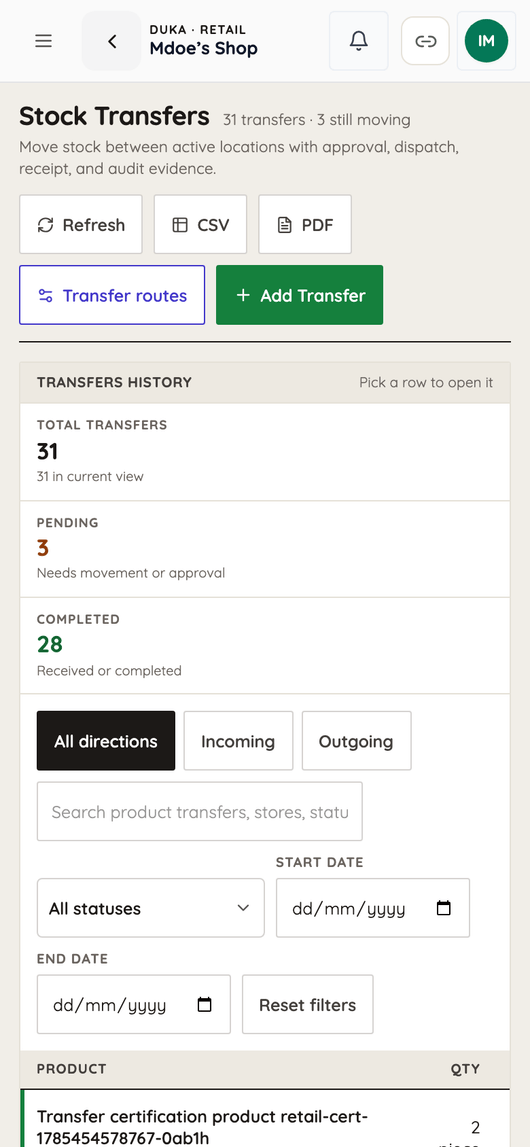
Transfers between branches
Send stock from one shop to another with a record at both ends, and see what is in transit.
Suppliers and purchase orders
Who you buy from, what you ordered, what arrived, and what you still owe them. Goods received before the invoice are tracked.
Import from Excel
Bring your product list in from a spreadsheet, with prices and opening stock. Export any report the same way.
Stock does not move without a name attached.
Most stock loss is not theft in the dramatic sense. It is a carton that was "borrowed", a count that was rounded, an adjustment nobody remembers making. Every change here carries the login that made it, and the ones that matter need approval first.
- Adjustments are signed. A count correction shows who made it, when, and the before and after.
- Approval queue. Stock-outs and transfers wait for a manager. Approved, rejected or pending — with the history.
- Stock valuation. What your stock is worth at cost, any day, for you and your accountant.
What is an inventory management system?
An inventory management system keeps the count of every product a business holds and changes it as things happen: a sale takes from it, a delivery adds to it, a transfer moves it, a correction adjusts it. Instead of a stock book that is right only on the day of the count, the count is right all the time — and the owner can see it from anywhere.
Stawi Biz keeps stock for shops, pharmacies, restaurants and warehouses in Tanzania. Stock levels update with every sale on the till, low-stock warnings reach the owner before a product runs out, transfers between branches are recorded at both ends, and taking stock out needs an approval. Suppliers, purchase orders and goods received are part of the same record, so what you owe a supplier and what they delivered are never in two different books.
Who is it for?
- Retail shops and mini-marts — hundreds of products, many units, one count that is always right.
- Pharmacies — the same stock control, plus batches and expiry dates.
- Distributors and warehouses — purchase orders, deliveries, transfers and stock in transit.
- Owners with more than one branch — each branch keeps its own stock; the owner sees all of them.
Stock control is in every plan.
Duka POS — sell, keep stock and see the day's report — is TSh 10,000 a month. Plans with suppliers, purchase orders, branches and transfers start at TSh 25,000. Every plan starts with 14 days free, no card.
Duka POS
Just the till: sell, keep stock, see the day
- Sell from a phone, a computer or the installed till
- Stock that drops with every sale, and a warning when it runs low
- Today's sales, profit and cash on your phone
No customer book, credit sales or WhatsApp — those start at Starter.
Starter
Add customers, credit and WhatsApp
- A customer book: who buys what, and how often
- Sell on credit (mkopo) and see who owes you
- Receipts and alerts on WhatsApp
Professional
Alerts, campaigns and up to five branches
- See what each cashier sold, and when
- Debt reminders go out by SMS on their own
- Alerts when stock goes missing, a product stops earning, a regular stops coming or a debt goes late
- Ask for today's report on WhatsApp
- Send offers by SMS or WhatsApp to all your customers, or a group of them
- Reports as PDF or Excel, to download, print or send
- Which products, hours and staff make you money
- Suppliers, purchase orders and what you owe them
- An online shop your customers order from
Enterprise
No limits, mobile-money collection, training
- Collect M-Pesa, Tigo Pesa and Airtel Money in the app, with payment links
- Priority support on WhatsApp
- Training for your staff
Inventory questions, answered
Does stock update when I sell?
Yes. Every sale on the till takes from stock at that moment, so the count on your phone is the count in the shop.
Will it warn me before a product runs out?
Yes. Set a reorder level per product. When stock falls below it, the product is listed on your dashboard and in the evening report.
Can I move stock between my shops?
Yes. A transfer is recorded at the sending and receiving branch, needs approval, and you can see what is in transit.
Can I import my products from Excel?
Yes. Upload a spreadsheet with names, prices and opening stock. Reports export to Excel, PDF or CSV.
Does it track what I owe suppliers?
Yes. Purchase orders, goods received and supplier invoices are recorded, so what you owe each supplier is always visible.
Is there a free trial?
Yes — 14 days free on any plan, with no card.
Count once. Then stop counting.
Bring your product list in from Excel and let the till keep the count from there.